6.6.14

OF TSUYU AND MONSOONS


I had to learn it the hard way : if there is one thing it is okay to steal in Japan, it's an umbrella. The rainy season started today, and with it, pouring rain and umbrellas everywhere, growing out of subways and buildings like mushrooms out of humid moss. Commonly referred to as tsuyu, it soaks Tokyo twice a year, and drowns all chances of a dry day. Rain in Japan is nothing like rain in Europe or anywhere I have lived. Imagine buckets of water being thrown on you repeatedly, all day long. The drops can come at anytime, startled you when you thought you were done for the week, or announce themselves the night before, drumming on the rooftops. For those of you who have never experienced a rainy season, ever, anywhere, I strongly advise you spend the rest of your life avoiding it. Come June, Tokyo gets swallowed in a humid, humid, humid and hot bubble, to the point that the Japanese have come up with the clever  蒸し暑い, mushiatsui expression - humid and hot. While I have shivered under cold rain in Normandy, Japan offers a different precipitation experience, creating interesting umbrella jams on the streets, and a delicate perspiration scent on the subway. People become sweaty animals, sweat salary men with their hentai manga, sweaty teenagers fooling around, soaked and slippery floods. Home becomes a sweet haven for dryness and cool. As it does for extremely cold weather, the idea of going out raises numerous problems : what shoes am I willing to ruin, bike, foot or subway, should I wear a poncho that will cover my whole body, what umbrella am I willing to part with in the event that someone-with-no-soul steals it.

As the rain falls and cover all with a glossy layer, as streams form in the most shapely sidewalk crack, I try to convince myself I will be able to find some poetry in this rainy season. I remember staring at the white-grey sky, counting the drops falling to my face as I wondered if all this could become wonderful, if caught in a photograph or if approached with an open-mind. Then I looked at the weather for the next days, and realized the sound of rain drumming against my window and roof, surrounding us all, would not stop tomorrow, nor the day after. We are, for a yet unknown period of time, bound to the falling rain.

On that note, I am highly considering buying sun jellies. I would have to get them imported, which begs the question of whether this tsuyu is worth it.

OF SHAMISEN, KIMONOS, AND ONE STEP FORWARD JAPANESE CULTURE ENLIGHTENMENT

The Tokyo skytree from afar

Konbanwa!
It is about time for some bunka talk. Bunka meaning culture, of course. It is beautifully written 文化 in that amazing language I would like to call my own one day (yes I mean Japanese).

Anyhow.

A few weeks ago, Waseda let us breathe for a week, during the oh-so-blessed Golden Week. It's technically more like almost-juxtaposed national holidays, but my oh-so-liberal (not sure one has to do with the other) host university, 早稲田大学 (Wasedadaigaku), treated us with an entire week of freedom. It was time to rest, and catch up on my cultural outings, which have become increasingly rare, in correlation of course with weekly workload, bad weather (rain in Spring, really?) and upcoming deadlines I could not escape. For my own good, I planned ahead: my friend Mika - an amazing girl may I add - told me about an organization through which she had already done one cultural event, specifically the visit of Ueno Park. She had loved it (and wrote a sweet article about it on her own blog) and wanted to attend the shamisen and kimono workshop. We signed up, and there we were, adding the event to our calendar.

D-day arrived and my friend Mika and I attended the small cultural event organized by PEACE, an association mainly ran by retired Japanese people eager to speak English and share their knowledge about Japan. On a very very sunny day, we met a middle-aged woman - Mrs Abe if I recall correctly - at Inaricho station, in Tokyo. She led us to a private house, where a line of old Japanese women were waiting for us in a small tatami room. They were adorable, curious eyed and smiles upon their faces.

One of the women stood in the corner, looking regal in her green kimono, introduced herself as the shamisen professor. She had a wise smile, welcoming us in her home, but you could tell she ran the place. Folded kimonos were set up on the floor. "They're for us", we thought, as we started to spot the one we'd rush to when the time came. I'm a sucker for blue fabrics, so I picked out a blue yukata, with red and yellow flowers. We also had to choose a opi (帯), more specifically tsuke obi with a separate bow, worn with an obijime. The obijime is a thin decorated sash, used to tighten the obi.

After first introductions, we picked a yukata or kimono, and suddenly felt like Disney princesses, being dressed by adorable women. Their gestures were quick and precise, tucking in any misplaced fabric. They laughed among themselves, especially since they were not all use to dressing someone in kimono, or had forgotten the right folds and knots. The fabric battle over, a bow was placed on our obi, straightening our backs. I must admit it felt very unnatural to have such a big bow on your back. Curling our back was not an option, and our new attire made us feel as though every move was to be delicate, every step light. It's harder to wear than a pair of jeans, and we wanted to appear as graceful as possible, to honor the women's kindness. So we took small steps on the tatami, and refrained from big gestures. We also snapped a few pictures, but Mrs. Abe (mother, not grandmother) insisted on taking photos of us

Mrs. Abe's host daughter, from Taiwan. Jealous of her kimono

My beautiful friend, Mika

The most important part of the morning came after. The shamisen professor (Mrs Abe) asked Mrs. Abe (her daughter, so the mother, so the woman who picked us up - are you still following this?) to gather us, and so we did. We were asked to sit on benches, behind music stands. Before the lesson started, the 3 Abe women (grandmother, mother - the lady who picked us up from the station - daughter). The daughter was the least eager person in the room, but played beautifully with her obaasan (grandma) and okaasan. They interpreted Japanese folk songs, such as "Sakura". The sensei (professor, a term widely used in Japan. Seriously, it's a must know) made us sing along:

sakura sakura


yayoi no sora wa

mi-watasu kagiri

kasumi ka kumo ka

nioi zo izuru

izaya izaya

mini yukan


Trust me if you sing this song anywhere on the street, someone will know what you are singing. It's quite pretty, see for yourself:


The score of sakura folk song


Cherry blossoms, cherry blossoms,

Across the spring sky,

As far as you can see.

Is it a mist, or clouds?

Fragrant in the air.

Come now, come now,

Let's look, at last!


If you find anything better than watching sakura (桜) bloom, do let me know.

 The sound of the shamisen is very unique and the first notes transport you directly to the country of the Rising Sun. It can be incredibly soothing, but the trio also interpreted a mambo rhythm in shamisen, which was a bit catchier. The instrument itself sort of looks like a 3-stringed banjo, but it is played with a big plectrum, called a bachi. I am not very musical of a person, but some people picked it up quickly. We had to play and sing along the shamisen professor instructions, which turned out surprisingly okay. But I'm sure it would take years of practice to master the musical subtlety of the shamisen.

Overall, the shamisen lesson was over too soon, but Mika, Helen (a friend who was coincidentally attending as well!) and I had a lot of fun playing kimono ladies and posing with our intriguing instruments. It was also great to interact with old people eager to give their time and share their knowledge about Japan. I'm always a fan of learning new things about mysterious Japan and falling a little more in love.

Oh and after this entertaining morning, we found unwanted thrown away flowers and brought them home. The last one died today, about 3 weeks later. This city is full of surprises (including the Tokyo skytree sight, see above)


20.4.14

THE FUJI EXPEDITION


I realized I had never talked about our climb of Mount Fuji. In September, Mathilde, Victor, Ambroise, my father and I packed our backpacks and left for Mount Fuji at around 21PM, in order to arrive around midnight at the start of the Mt. Fuji climb. We pilled layers of clothes, and put some extra socks and extra warm layers in our backpacks, added some cereal calorie bars, mini oxygen bottles, headband lamps, gloves, water, and took the road. At the site, one bathroom break, a warm coffee from a vending machine, and off we went in the night. There are two ways to climb Mt. Fuji, and we chose the night climb, so as to admire the sunrise from the top. This meant we had to get to the summit before 5ish. As 5 light spots in the night, we walked, and walked, and climbed. At some point your legs do not want to carry you anymore, your lungs are tired from the lack of oxygen, you're thirsty, you're hungry, you need a break. We had energy bars and energy jelly (all Japanese outdoors stores sell them, and they have very interesting flavors, although new culinary experiences are the last thing you want to do while climbing Mount Fuji), and, while most rest stations were closed (because of the season), we took several breaks. It wasn't all stairs and fun, sometimes we had to have to use our hands to climb rocks. After about 5 hours of tremendous effort, our legs carried us to the summit. That moment when you realize you have reached the top is golden. We had just enough energy to take some photos, and congratulate ourselves for making it to the summit ... until we realized we had to hike down the mountain. All we wanted to do is roll down, but somehow we carried ourselves back to our car, and looked for an onsen that would rinse off that tiring night and soothe our exhausted muscles.


The tired bunch, 3250m
Go team LH

KANAMARI MATSURI, THE "PENIS FESTIVAL"


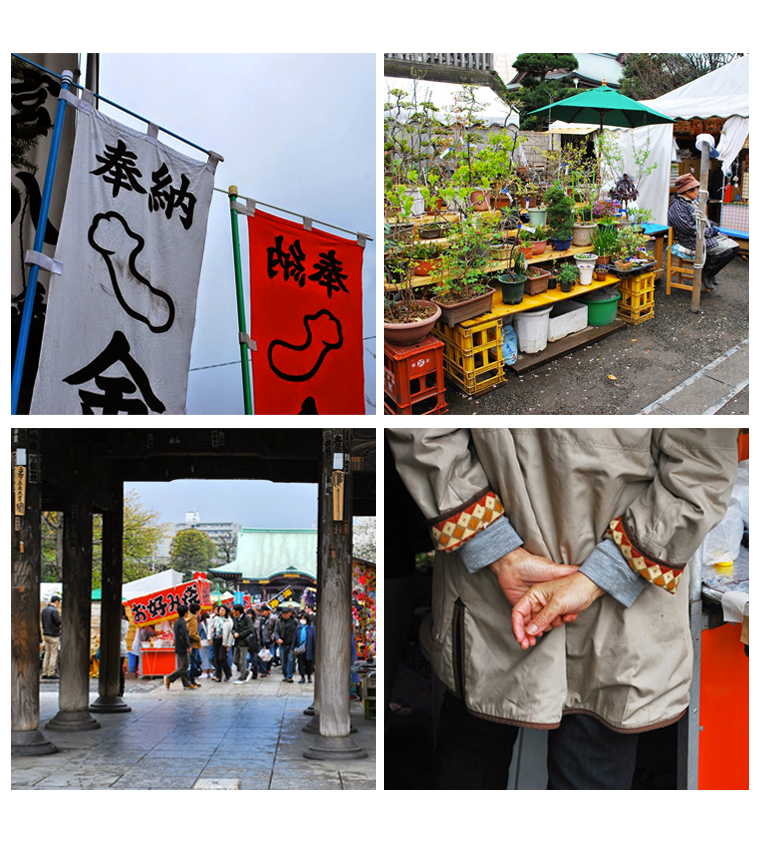
The Kanamari Matsuri was one of those festivals I had read about, but never thought I would attend. It is often referred to as penis festival, but more specifically it is a shinto (remember, there are two major religions in Japan, shinto and buddhist) celebration of fertility that occurs yearly on the first Sunday of April. At the center of this festival is the Kanayama temple, and a giant parade that celebrates three giant penises (one of wood, one of iron, and one pink, carried by men dressed as women), carried in mikoshi (divine palanquin, or portable shinto shrine) throughout the city streets.


I do love a good matsuri. There is always good food, a great celebratory atmosphere, dances, people, and so on, but this one was a short party. Not only did we get hit by bad weather (it seems as though bad weather is all I get when I decide to get out of the city), but I was disappointed by the execution in itself. It was actually a big gaikokujin fest, and lacked Japaneseness. I quickly put my camera back in my bag, as it started pouring. Despite the rain, and the beer-inhibited tourists, it was an interesting experience, and we got to bring back genitals lollipops!


Happy Victor

The star


GETAWAY : GREEN GREEN KAMAKURA


There comes a moment in your Tokyo routine when you need to take a step out of the city and embrace the green-ness around the capital. Away from the concrete and to Kamakura we went. Kamakura is a very popular destination, about one hour away from the city center. It is very well known for its giant buddha, Daibutsu, and for its zen temples. Just what Fiona and I needed to rinse off the city dust! While the weather was not as beautiful as we had hoped, we were lucky to be close to alone to visit the zen temples. The silence and beauty of the surrounding nature, and the spirituality of the temples, was definitely a relaxing experience.


Under an unpleasant gray sky, we started off our visit at Kita-Kamakura. You can also start your visit at Kamakura, and work your way to the many temples of the area. About 50m from the mini station of Kita-Kamakura, we entered the Engakuji zen temple. No one in sight but two or three couples. Had the sun peaked from behind the clouds, we would have dropped our bags and stayed there, under the leave roofs overlooking the temple. It was beautifully calm, a truly soothing experience. The tones of green around us were mesmerizing, and created a very Japanese zen atmosphere.


Ticket to Engakuji temple

Stairs to the temple


Zen Japanese beauty
More of Engaku-ji


Next, we headed towards Tôkei-ji and Jôchi-ji, on the other side of the train tracks. We adventured towards Genjiyama Park and followed the Daibutsu Hiking course, leading to the Kuzuharagao-ka sanctuary. We walked, and walked, and walked, on a jungle-y path, hurrying to arrive at the Daibutsu before sunset.


Up we go

In the jungle

We walked and walked and walked in a tree tunnel, and finally reached the road to the Daibutsu. We hurried to the temple and barely made it before closing time. I therefore advise everyone to arrive before closing time, 17:30PM, so as to not be kicked out by the Daibutsu guards.


For big buddha, keep walking

Big buddha and little buddha

As great as this getaway was, we were relieved to step on the JR back to Tokyo, as Kamakura became dark and colder. We were tired but happy, ready for our gyoza soup waiting at home.


Bye bye green

A PINK POST FOR SPRING